
Most end customers and commercial installer clients see a solar-powered sign as a simple fixture with a panel attached. They rarely appreciate the engineering, site-specific variables, and load calculations required to keep the system running reliably 365 days a year without grid backup.
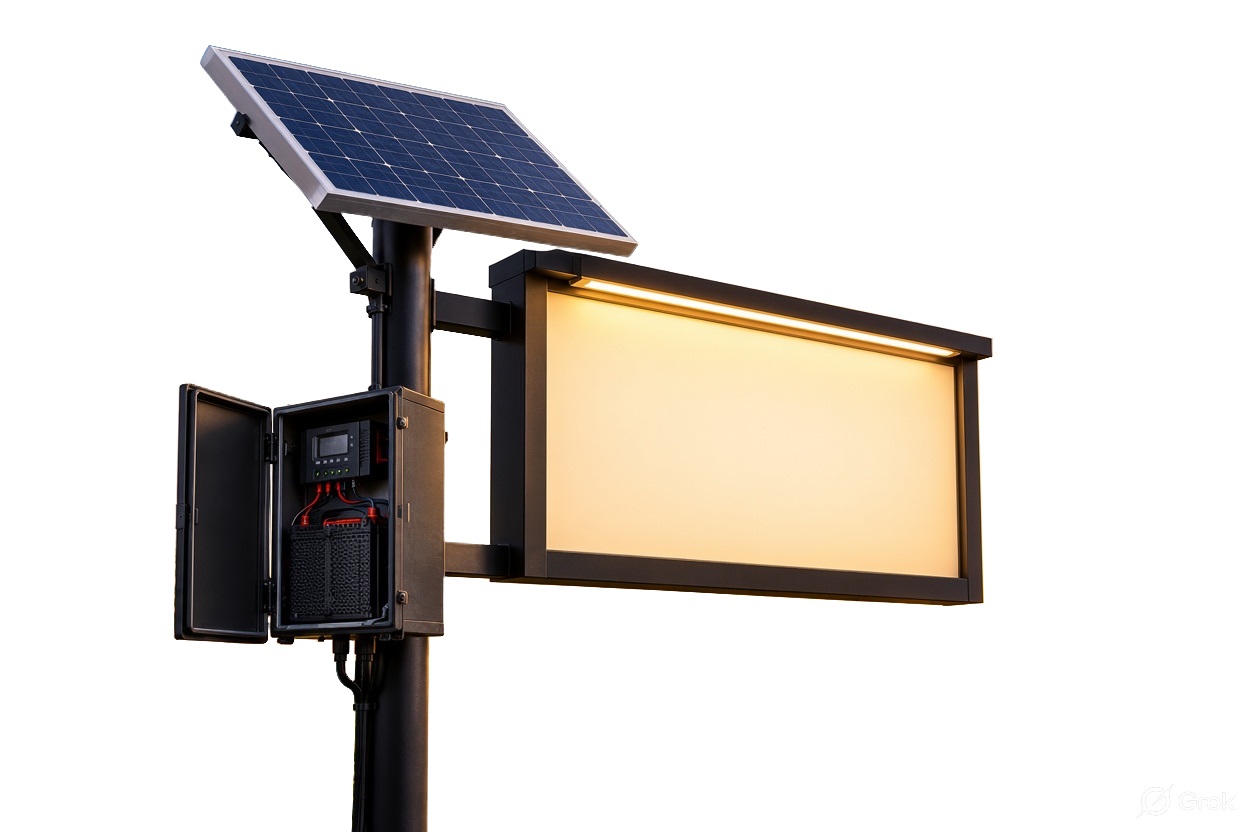
Here are the key factors clients routinely overlook when specifying off-grid solar sign power:
1. Autonomy Days & Weather Contingency
Clients assume a solar panel powers the sign day to day. They often fail to plan for 3 to 5 consecutive overcast, snowy, or rainy days. This requires sizing a larger LiFePO4 or deep-cycle AGM battery bank to prevent total blackouts.
You also need a solar panel that can do more than charge the power used the previous night. It needs enough capacity to help recover from cloudy weather from the previous day.
2. Sun Hours vs. Daylight Hours
Daylight does not equal peak sun hours. Solar panel sizing depends on regional solar insolation rates, such as 3 peak hours in winter versus 6 in summer. Seasonal sun angles also affect panel wattage and tilt requirements.
Look at your sign placement location on Sun-In-One’s Zone Chart. It is based on the worst solar month of the year in those areas.
3. Shading & Placement Constraints
Tree canopies, neighboring buildings, and winter shadow lengths can drastically reduce output.
Clients frequently want to mount panels directly on or behind the sign for aesthetic reasons, regardless of southern exposure or shading.
Even a little shade can reduce the production of a solar panel by up to 50%. You can still use solar, but you need a kit that can adjust to partial shade with a larger panel. This allows it to charge faster during the shorter period before it becomes shaded.
4. Line Loss & Voltage Drop
Running DC power from a remote solar array to the sign structure introduces line loss over long distances.
Cables must be properly sized or gauged to keep voltage drop under 3% so LEDs maintain their rated brightness.
5. Inrush Current & Duty Cycles
High-efficiency LED drivers can draw an initial surge of power, known as inrush current, when powering on at dusk.
Without proper charge controller and circuit breaker sizing, such as UL 489A standards, this surge can trip the controls.
For example, one-size-fits-all solar kits may not be designed to handle these inrush currents. Even if the operating wattage works with the solar kit, the system can stop working because of this issue.
6. Sign Operating Schedules
A sign running 14 hours per night in winter requires significantly more power than one running 8 hours in summer.
Automated timers, dusk-to-dawn sensors, or dimming profiles are essential to balance power budgets.
7. Other External Factors
Other things can also affect a solar lighting kit.
For example, if a streetlight is nearby, the solar panel can receive some voltage from the light. This can prevent the system from turning on.
Unless your system can be adjusted, your system may never work correctly.
Most non-commercial-grade systems do not have this feature. Check for this before you purchase anything.
8. Shopping on Price
When you do not know what is included, be prepared for added expenses.
This includes the length of wire needed to reach from the lights to the battery or control box. Fixing this issue can cost additional time and money.
Is the battery box included? You have to ask because some companies cut the price by not including the battery or battery box.
Some systems use lead-acid batteries instead of LiFePO4 batteries with heaters or AGM batteries for cold climates.
Others do not include the racking needed to mount the solar panel to a pole or roof.
If a kit has a 1-year warranty versus a 5-year warranty, it may be cheaper, but there could be a cost in terms of longevity.
9. Can the System Be Maintained?
Is your kit designed to be serviced in the future, with all components being replaceable?
Can you get 20 to 30 years of service out of the product, or is it disposable if it stops working?